
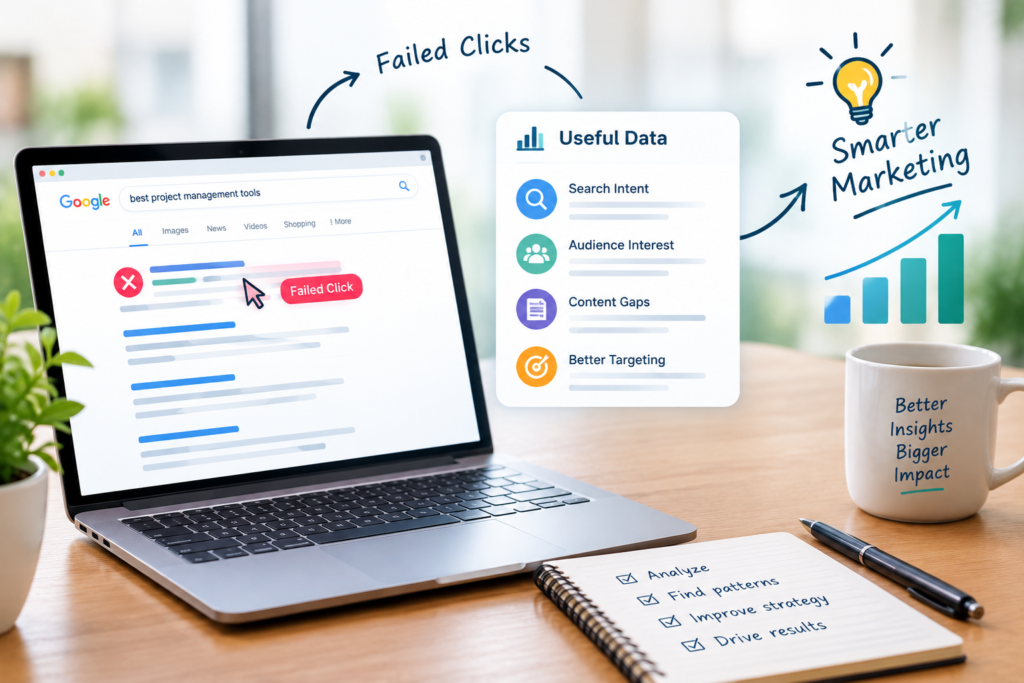
Most marketing reports are designed to celebrate what worked.
The campaign generated 40 leads. Organic traffic increased. A keyword moved onto page one. Cost per conversion declined.
What happens to everything that didn’t work?
A paid search campaign may spend hundreds of dollars on queries that never produce an enquiry. An SEO page might appear thousands of times in search results while attracting very few clicks. Another page could generate substantial traffic but almost no commercially useful action.
Businesses normally classify these outcomes as waste.
But some of the most valuable search intelligence can be hidden inside unsuccessful interactions.
Instead of simply eliminating failed clicks, irrelevant queries and unproductive traffic, businesses can create a search waste exchange: a system where information about what failed in paid search is used to improve SEO, while organic search failures become intelligence for paid campaigns.
The result is a marketing strategy that learns from money and attention that have already been spent.
Every Failed Search Interaction Leaves a Clue
Imagine a Boston-based B2B company running a paid search campaign.
During the month, it pays for 1,000 clicks. Fifty visitors become leads.
Naturally, reporting focuses on those fifty conversions.
But the remaining 950 clicks contain information too.
Some visitors may have used irrelevant search terms. Others were interested in the right service but looking for a different price point. Some reached the website and immediately realised the offer wasn’t suitable.
A portion may have been genuinely interested but encountered a weak landing page.
Calling all 950 clicks “non-conversions” hides those differences.
The better question is:
What did we learn from the people who didn’t convert?
Once that question is asked systematically, advertising waste becomes research data.
Paid Search Can Become a Search-Intent Laboratory
SEO teams often use keyword research tools to estimate what people search for.
Paid search can provide another type of insight.
It can expose real search behaviour around a commercial offer.
Search term reporting can reveal unexpected ways people describe a service, modifiers associated with different stages of the buying journey and searches that initially appear relevant but consistently produce poor outcomes.
Suppose a company assumes that people searching for a particular service are potential buyers.
After several months of advertising, it discovers that a large percentage are actually students researching the topic, job seekers looking for employment or consumers trying to solve the problem themselves.
That isn’t simply wasted advertising spend.
It is evidence about the ambiguity of the search market.
SEO can use that information before investing months trying to rank organically for the same terms.
Negative Keywords Can Inspire Positive SEO Decisions
Negative keywords are normally treated as a PPC housekeeping task.
A search term produces irrelevant traffic, so it gets excluded.
But imagine collecting those exclusions for six months and reviewing them as a dataset.
Patterns could emerge.
Perhaps customers repeatedly confuse one service with another. Maybe people use terminology differently from how the business describes its offering. A particular keyword might attract huge interest from an audience the company doesn’t serve.
These patterns can inform website content.
If potential customers frequently misunderstand the difference between two services, the business could publish a comparison page explaining that distinction.
If people repeatedly search for a service the company doesn’t provide, the website could clarify its scope more explicitly.
A negative keyword can therefore become a positive content opportunity.
SEO Has Waste Too
Organic search feels less expensive because businesses don’t pay every time someone clicks.
But organic traffic still consumes resources.
Pages take time to research, write, design, optimise and maintain. Developers implement technical changes. Specialists build internal links. Businesses may spend months trying to improve rankings.
A page that receives large amounts of irrelevant traffic therefore isn’t necessarily a success simply because the traffic is “free.”
The same applies to impressions.
A page might appear thousands of times for searches that are loosely related to the business but have almost no commercial relevance.
This is SEO waste.
The cost isn’t charged per click. It appears as time, opportunity cost and attention.
High Impressions and Low Clicks Can Become Ad-Copy Research
Google Search Console can reveal queries where a website appears frequently but attracts relatively few clicks.
Some of these situations are perfectly normal. Search position, SERP features and user intent can all affect click-through rates.
Others deserve investigation.
Perhaps the page title doesn’t communicate the offer clearly enough. Maybe the searcher’s real question isn’t being addressed. The website could also be appearing for an adjacent intent that doesn’t match the page.
Instead of immediately rewriting the page, businesses can use paid search to test different messages.
Advertisements can provide a faster environment for comparing propositions, terminology and calls to action.
If a particular message consistently attracts more relevant engagement, that insight can inform future organic titles and landing-page content.
PPC becomes a testing environment for SEO decisions.
Organic Search Can Identify Expensive PPC Mistakes Before They Happen
The exchange works in the opposite direction too.
Suppose Search Console shows that a website receives impressions for a particular commercial-looking query.
At first glance, it seems like an obvious paid-search opportunity.
But organic performance reveals something unusual.
Visitors reaching the relevant page rarely enquire. They spend little time exploring the service and frequently leave.
Before purchasing significant paid traffic for the same search theme, the business can investigate why.
Perhaps the query has mixed intent.
Maybe the landing page is inadequate.
Or the service isn’t actually competitive for that audience.
Organic data has provided an early warning.
The company can resolve the issue before paying for additional traffic.
The Most Expensive Keyword Isn’t Necessarily the Biggest Waste
Marketing teams often look for wasted spend by sorting keywords according to cost.
The expensive keywords receive attention first.
But cost alone doesn’t identify waste.
A keyword costing $2,000 per month that generates three valuable customers may be considerably more useful than a keyword costing $400 that generates twenty poor-quality leads.
This is why businesses using PPC management Services in Boston should ideally connect advertising data with outcomes beyond the initial form submission.
Google Ads supports qualified and converted lead goals specifically to help advertisers measure deeper stages of the lead-to-sale journey and use offline information to distinguish promising leads from initial submissions.
Once lead quality becomes visible, the definition of wasted spend changes.
Create a Search Graveyard
Most businesses maintain lists of target keywords.
Few maintain a structured record of keywords they deliberately stopped pursuing.
A search graveyard can capture these decisions.
Suppose the company tests a search theme and discovers that it attracts the wrong audience. Instead of simply excluding the term and forgetting about it, record why it failed.
Perhaps the intent was informational rather than commercial.
Maybe customer acquisition costs were unsustainable.
Perhaps the service generated leads but very few qualified opportunities.
Months later, when someone proposes targeting the same topic through SEO, the organisation has evidence explaining why that idea was previously rejected.
The graveyard prevents marketing teams from repeatedly paying to learn the same lesson.
Build a Search Misunderstanding Library
Some failed searches reveal something even more useful than poor performance: they reveal misunderstandings.
Imagine customers frequently searching for a term that technically describes one service but using it when they actually need another.
That mismatch might repeatedly appear in paid search terms, organic queries and sales conversations.
Instead of viewing those searches as irrelevant, businesses can create content around the misunderstanding.
An article could explain the difference between the two services. A service page could address the confusion directly. Paid ads could qualify users before they click.
This transforms wasted traffic into customer education.
The business becomes more useful precisely because it understands where customers get confused.
“Near Me” Searches Can Reveal a Different Kind of Waste
Local search creates its own version of the problem.
A business may pursue local visibility because location-based terms appear commercially attractive. But the meaning of proximity differs dramatically between industries.
Someone searching for an emergency plumber probably cares considerably about physical proximity.
Someone looking for a specialised consultant may use local language while being perfectly comfortable working remotely.
Google says local results are mainly influenced by relevance, distance and prominence, with distance determined relative to the searcher’s location.
For a business targeting SEO Agency near me, the important question therefore isn’t simply whether local visibility exists. It is whether the people discovering the business through local-intent searches actually resemble the customers the company wants.
Local rankings that generate irrelevant enquiries aren’t necessarily valuable rankings.
Let Sales Decide What Counts as Waste
Marketing platforms can identify non-converting clicks.
Sales teams can identify a different problem: converting clicks that produce bad leads.
Suppose a campaign generates 30 form submissions.
Advertising reports them as 30 conversions.
Sales discovers that ten are job seekers, eight want services the company doesn’t provide, five have unrealistic budgets and only seven are genuine opportunities.
From the platform’s perspective, the campaign produced thirty successes.
From the business’s perspective, it produced seven.
This information should travel back into search strategy.
Google explicitly recommends optimising lead-generation campaigns around meaningful conversion goals and deeper-funnel actions where possible, rather than relying only on shallow lead volume.
Sales feedback therefore isn’t merely useful for CRM reporting.
It is search optimisation data.
Create a Monthly Waste Meeting
Marketing meetings normally focus on growth.
A monthly search waste review could deliberately do the opposite.
Instead of beginning with the best-performing campaigns and pages, start with money and attention that produced disappointing outcomes.
Examine expensive searches that didn’t generate qualified opportunities. Review organic pages receiving substantial visibility without meaningful engagement. Look at repeated irrelevant enquiries and search themes that appear in both paid and organic data.
Then ask whether the failure contains information another channel could use.
A bad PPC query could become an SEO exclusion.
A weak organic title could become an ad-copy test.
A repeated irrelevant enquiry could suggest stronger landing-page qualification.
A high-converting paid search term could become a priority for long-term organic visibility.
The objective isn’t simply to eliminate waste.
It is to recycle the information contained inside it.
Give Failed Experiments an Expiry Date
A keyword that failed two years ago doesn’t necessarily deserve permanent exclusion.
Markets change.
Prices change.
The company’s offer may improve. A weak landing page may have been replaced. Competitors may leave the market, while customer terminology can evolve.
For that reason, failed experiments can be given review dates.
A search theme rejected because of poor lead quality might be reconsidered after a year if the service has changed substantially.
This prevents the search graveyard from becoming a permanent blacklist.
Past failure becomes evidence, not a rule.
Stop Paying Twice for the Same Lesson
The biggest advantage of connecting PPC and SEO isn’t simply that the channels can support one another.
It is that the business can avoid learning the same thing twice.
If paid search has already demonstrated that a query produces poor-quality leads, the SEO team should know before investing heavily in ranking for it.
If organic data reveals strong demand for an unexpected service, paid search should know before planning its next campaign.
If sales repeatedly rejects leads associated with a particular intent, both channels should learn from that information.
Marketing becomes more efficient when knowledge survives the boundary between platforms.
Your Failed Searches May Be More Valuable Than Your Successful Ones
Successful searches tell businesses where things are working.
Failed searches often explain why things aren’t.
They expose ambiguity, customer misunderstandings, weak offers, unsuitable audiences, landing-page problems and gaps between marketing conversions and actual business value.
That makes them useful.
The goal isn’t to celebrate wasted advertising spend or irrelevant organic traffic.
It is to stop throwing away the intelligence those failures produced.
The next time a marketing report shows an expensive keyword with no conversions, don’t immediately ask only:
“Should we pause it?”
Ask a second question:
“What did we just pay to learn?”
The answer might improve far more than one campaign.
You can also read about: Discover Tonight’s Moon Phase with This Simple Guide!